What an IVF cycle looks like, step by step
An IVF cycle usually runs about four to six weeks of active treatment. You take hormone injections for around 8 to 14 days to grow several eggs, have a timed trigger injection, then a short procedure to collect the eggs. The eggs are fertilised in the lab, the embryos grow for five to six days, and one is placed in the uterus. About two weeks later, a blood test shows whether it worked. This guide walks through each step in plain language, with what to expect, realistic numbers, and what to do if a cycle does not go to plan.
Written by Fertility Decoded. Reviewed by D R, MS (OBG), FRM. Review date: 29 August 2026.

An IVF cycle can feel like a lot of unfamiliar steps packed into a few intense weeks. It helps to see the whole path first, then understand each part. In short: you take medication to grow several eggs, the eggs are collected and fertilised in a laboratory, the resulting embryos grow for a few days, and one is placed into the uterus. About two weeks later, a blood test tells you whether a pregnancy has started.
Most cycles take roughly four to six weeks of active treatment, or about six to eight weeks from your first planning appointment to the pregnancy test. Your clinic will give you a personal calendar, because the exact timing depends on your body and the protocol they choose.
The cycle at a glance
Getting ready
days to weeks
Baseline checks, consent, and your medication plan. Sometimes a few weeks of preparation come first.Ovarian stimulation
~8 to 14 days
Daily hormone injections grow several follicles, tracked by scans and blood tests.Trigger injection
one evening
A single, carefully timed injection matures the eggs.Egg retrieval
~20 to 30 min
A short procedure under sedation collects the eggs from the ovaries.Fertilisation
day of retrieval
Eggs and sperm meet in the lab, by standard IVF or by ICSI.Embryo growth
5 to 6 days
Embryos are grown and checked in the lab, often to the blastocyst stage.Embryo transfer
quick, no sedation
One embryo is placed in the uterus, fresh or thawed from frozen.Two-week wait and test
~9 to 14 days
A blood test confirms whether a pregnancy has started.
Want to see these steps mapped onto your own dates? The IVF cycle calendar generator turns this sequence into a personal, printable timeline — and a download for Google or Apple Calendar — from just your cycle start date. Nothing you enter is stored or sent anywhere.
Step 1: Getting ready
Before the active cycle starts, your clinic confirms the plan. This usually includes a baseline scan of your ovaries and uterus, blood tests, a review of any earlier results, and signing consent forms. You will be given a medication schedule, taught how to do the injections, and told exactly when to start.
Some protocols add a preparation phase first, such as a few weeks on the contraceptive pill or a short course of medication to quiet the ovaries before stimulation. This is normal and helps the clinic control the timing.
Step 2: Ovarian stimulation and monitoring
Naturally, your body matures one egg a month. In IVF, the aim is to grow several at once, so there are more chances to create a healthy embryo. You do this with daily injections of gonadotropins, the hormones that drive your ovaries.
This phase is called ovarian stimulation and lasts about 8 to 14 days. Through it, you come in every few days for monitoring: a quick ultrasound to count and measure your growing follicles (the fluid-filled sacs that each hold an egg), plus blood tests to track your hormone levels. Your clinic uses these to adjust your dose and decide when your eggs are ready.
Step 3: The trigger injection
When enough follicles have grown to about 16 to 18 mm, your clinic gives you a final injection, the trigger shot. It prompts the eggs to finish maturing. The timing is precise: egg retrieval is booked for about 34 to 36 hours later, so following the exact time your clinic gives you matters more here than at any other point in the cycle.
Step 4: Egg retrieval
Egg retrieval (also called egg collection or OPU) is a short procedure, usually done under sedation, so you are comfortable and asleep or very drowsy. Using an ultrasound probe and a thin needle, the doctor gently draws the fluid, and the egg within it, from each mature follicle. It takes about 20 to 30 minutes, and you go home the same day after a short rest.
- You will usually be asked not to eat or drink for several hours beforehand.
- Arrange for someone to bring you home, as you cannot drive after sedation.
- If you are using a partner's or donor's sperm, confirm the arrangements for the sample that day.
- Plan to rest for the remainder of the day.
- Mild cramping and light spotting afterwards are normal; heavy bleeding or severe pain is not, so call the clinic.
The number of eggs collected varies a great deal. Many people get somewhere around 8 to 12, but a lower or higher number can still lead to a healthy embryo. More eggs is not automatically better, and quality matters as much as quantity.
Step 5: Fertilisation in the lab
The same day, an embryologist combines your eggs with sperm. There are two ways:
- Standard IVF, where eggs and prepared sperm are placed together in a dish and fertilisation happens on its own.
- ICSI, where a single sperm is injected directly into each mature egg. This is often used when sperm count or movement is low.
Not every egg fertilises. As a rough guide, around 80 percent of the mature eggs fertilise, but this differs from person to person.
Step 6: How embryos grow, and what the numbers really look like
Over the next few days, the lab watches the fertilised eggs develop. By about day three an embryo has six to eight cells. By day five or six, the strongest ones reach the blastocyst stage, a more advanced embryo with many cells, which tends to implant better.
Here is something many clinics do not explain clearly, and it is worth knowing so the numbers do not come as a shock: there is a natural drop-off at every step.
Embryologists also grade embryos, scoring how expanded a blastocyst is and how the two cell groups inside it look. Grading helps the lab choose which embryo to transfer first and which to freeze. It is a useful guide, not a guarantee, and a slightly lower-graded embryo can still become a healthy baby.
Step 7: Embryo transfer
In embryo transfer, the doctor passes a thin, soft catheter through the cervix and places one embryo into the uterus. It is quick, usually painless, and needs no sedation. Many people say it feels similar to a cervical smear test. You are often asked to come with a comfortably full bladder, which helps the doctor see the uterus on ultrasound.
Most clinics now transfer a single embryo to avoid the risks that come with twins. Any other good embryos can be frozen for later.
Fresh or frozen transfer
The transfer can happen in the same cycle as your egg retrieval (a fresh transfer), or your embryos can be frozen and transferred in a later, prepared cycle, called a frozen embryo transfer.
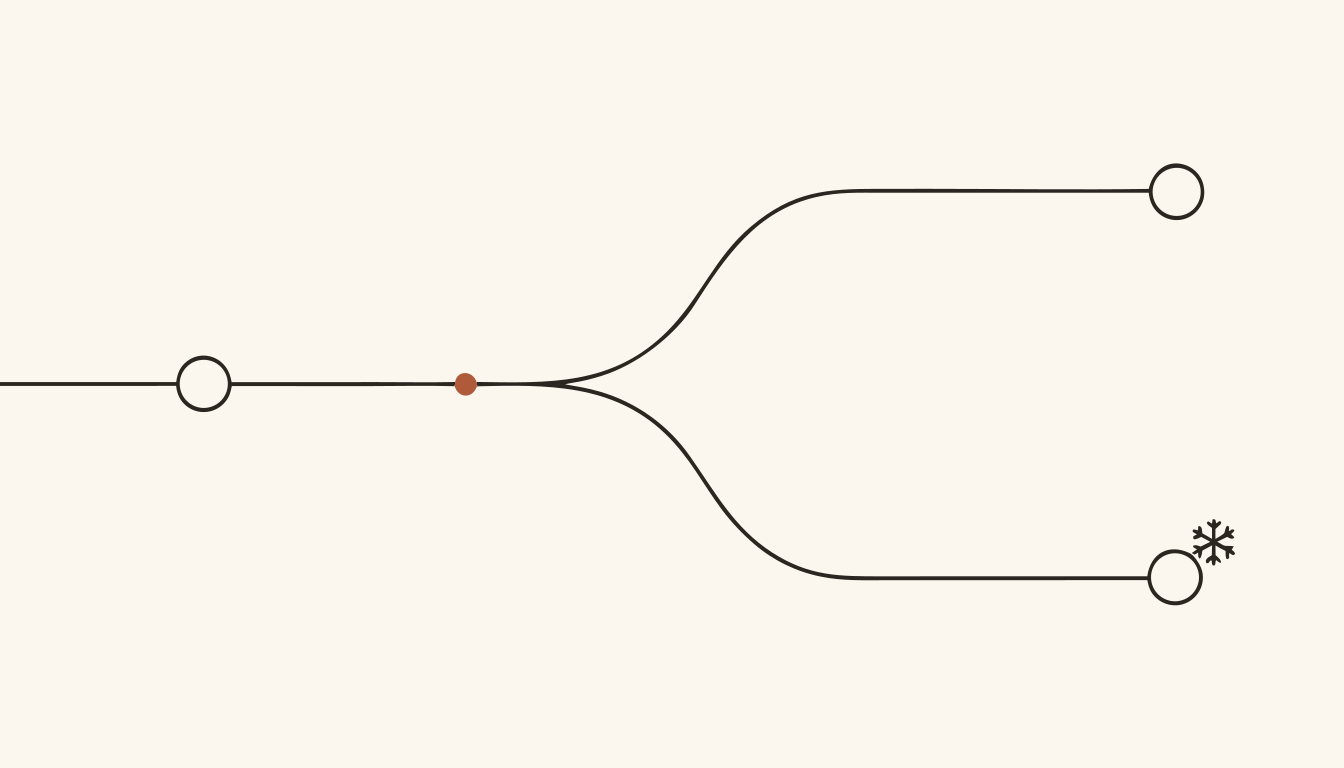
| Fresh transfer | Frozen transfer (FET) | |
|---|---|---|
| When it happens | A few days after egg retrieval, in the same cycle | In a later cycle, after the embryos are frozen |
| How the lining is prepared | Uses the lining built during stimulation | Prepared with oestrogen and progesterone, or in a natural cycle |
| Often chosen when | The cycle was straightforward and the lining looks good | Freeze-all, OHSS risk, awaiting genetic-test results, or to let the body recover |
| Flexibility | Less; timing is set by the retrieval | More; the transfer is scheduled when you are ready |
Freezing is now very reliable, and frozen transfers are extremely common, so being offered one is not a step backwards.
Step 8: The two-week wait
After the transfer comes the two-week wait, the roughly two weeks before your pregnancy blood test. Most people find it the hardest part of the cycle emotionally. A few things genuinely help:
- You do not need bed rest. Resting for a few hours after the transfer is fine, but lying down for days does not improve the chance of success, and the embryo cannot "fall out". If a day-five blastocyst was transferred, implantation usually begins within about one to two days.
- Gentle movement is fine and can help. Walking and light activity are encouraged when you feel up to it. Avoid heavy lifting, very intense exercise, hot baths, saunas, and swimming pools for the first few days.
- You will likely be on progesterone (as pessaries, gel, or injections) to support the lining. Take it exactly as prescribed.
- Symptoms will not tell you the answer. Cramping, bloating, sore breasts, and tiredness are common, but the progesterone causes the same feelings whether or not you are pregnant, so they cannot confirm anything either way.
- Try to avoid home pregnancy tests. They can mislead during this window, both with false hope and false disappointment, partly because the trigger injection can still be in your system. The clinic's blood test is the reliable answer.
At the end of the wait, the clinic does a beta hCG blood test. A single number means less than the trend, so it is usually repeated after about two days to check the level is rising as expected.
When a cycle does not go exactly to plan
It is worth knowing in advance that cycles do not always run straight through, and that variations are common rather than failures of you or your clinic:
- The cycle is paused or cancelled. If the ovaries respond too weakly, or too strongly (raising the risk of OHSS), the clinic may stop and adjust the plan for next time.
- Few or no eggs at retrieval, or eggs that do not fertilise. This is disappointing but does happen, and it gives useful information for a different approach.
- No embryo reaches the blastocyst stage. Sometimes embryos stop developing in the lab. It is hard news, and it points the team toward changes such as ICSI or a different protocol.
- A "freeze-all" cycle. Your clinic may freeze every embryo and transfer later, for safety or to await genetic-testing results. This is a planned choice, not a setback.
If any of these happen, ask your clinic what they learned and what they would change. A first cycle often teaches the team how your body responds.
Looking after yourself through it
An IVF cycle is physically and emotionally demanding, on you and on a partner if you have one. Hormones, frequent appointments, and the weight of hoping all add up. None of that means anything is wrong with you.
Lean on whatever support helps: a partner, a trusted friend, a counsellor, or a patient community. Good clinics offer counselling as part of care, so ask. Sharing the load, and giving yourself permission to feel however you feel, is part of getting through a cycle, not a luxury.
Side effects, and when to call the clinic
Most people get through stimulation with manageable side effects: bloating, mild tenderness, mood changes, and bruising at injection sites. These usually settle after egg retrieval.
A note on cost and medication
Medication is one of the biggest and most variable costs of a cycle, because doses are tailored to you and can change as the cycle goes. When you compare clinics, ask for a written, itemised estimate that includes the medication, the procedures, and anything likely to be added. Our guide on questions to ask your clinic covers exactly what to check.
Frequently asked questions
- About four to six weeks of active treatment, or roughly six to eight weeks from your planning appointment to the pregnancy test. Stimulation lasts around 8 to 14 days, embryos grow for five to six days, and the two-week wait follows the transfer. A frozen transfer is done in a later cycle, which adds time.
- It varies widely, but many people get somewhere around 8 to 12. A lower number can still produce a healthy embryo, and more eggs is not automatically better. Quality matters as much as quantity, and your age and ovarian reserve strongly affect the count.
- No. Resting for a few hours is fine, but staying in bed for days does not improve success, and the embryo cannot fall out. Gentle activity like walking is encouraged. Avoid heavy lifting, very intense exercise, hot baths, and swimming for the first few days.
- Wait for the clinic's blood test (beta hCG), usually about 9 to 14 days after the transfer. Home pregnancy tests during the two-week wait can mislead, partly because the trigger injection can still be in your system, so they often cause false hope or false worry.
- A drop-off at each step is normal. Not all eggs are mature, not all mature eggs fertilise, and only some fertilised eggs reach the blastocyst stage. Ending a cycle with one or two strong embryos is a good outcome. Your clinic can explain what your own numbers mean.
- Often it takes more than one cycle, and that is common rather than a sign of failure. Each cycle also teaches the team how your body responds, which can improve the plan next time. Ask your clinic to review what they learned before deciding on the next step.
How long does one IVF cycle take?
How many eggs is a normal number to collect?
Do I need bed rest after the embryo transfer?
When can I take a pregnancy test after IVF?
Why did so few of my eggs become embryos?
Is one IVF cycle usually enough?
Next: read what is IVF? for the basics, the questions to ask your clinic, or browse the registered-clinics directory.
Sources and further reading
- HFEA: In vitro fertilisation. IVF stages.
- ESHRE: Ovarian stimulation guideline (2025). Stimulation and trigger planning.
- ASRM: Performing embryo transfer (2017). Transfer practice and bed-rest evidence.
Timings and example egg counts are orientation, not a forecast or an Indian clinic benchmark.
Source links checked on 7 September 2026. This source check is separate from medical review.
Related
Last updated .